How We Care for Newborn Beef Calves on Our Cow-Calf Operation
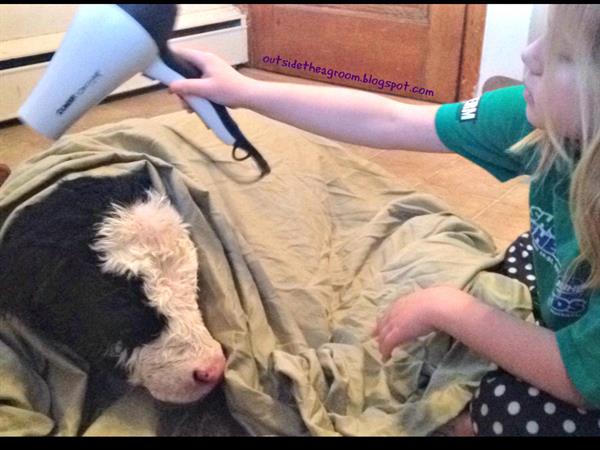
This newborn black-white faced beef heifer calf was born outside on a sub-zero February morning. Her mother, a first-time mother no less, showed no signs of being close to calving the night before (hence the reason she was born outside). Right off the bat, during morning chores and calving checks, my husband noticed her. I was inside getting ready to go to work when I heard the truck back up to the door and moments later I had a newborn calf on my kitchen floor.
And just like that my super soft, but worn out king size sheets were being used to warm up this little icicle of a babe. My blow dryer that was on its last leg was getting a workout. The calf’s little ears were frozen and at risk of frostbite. I dried her, my daughter dried her, I dried again and we kept taking turns. After about an hour inside, this little sweetie was back in the barn with her mother & ready to take on the world. She needed a little extra help nursing for the first time and getting that ever so important colostrum (first milk from her mama) into her system.
About Cow-Calf Operations
Our beef cattle operation is called a cow-calf operation. A cow is a female bovine that has birthed a calf. The cows on our farm range in age from 3 – 15 years old. The goal of our operation is for our cows to produce calves that will yield high quality meat cuts that are in demand in the marketplace.
Calving Season at Our Operation
Most of our cows ultimately move on from our operation to supply beef to the marketplace. However, we keep the top performing heifers as replacement heifers to replace older cows or cows that have struggled when raising a calf. While providing our customers with high quality beef is very important to us, it is equally important that the animals we raise are done so humanely and live a quality life on our farm.
When explaining to others how we go through our “heavy bred” pen every night during calving season to determine which cows need to be put in the barn for the night, some may say that we are babying them. Some statements made have been such as, “A good cow that is bred right should be able to have a calf unassisted” or “if you help them all the time they will never try to have a calf on their own”.
My immediate response to these comments is always that every operation is different and every producer can run his/her operation the way he or she sees fit, which is exactly what we do.
My husband and I both have full-time jobs off the farm, therefore our operation is more like a hobby. It takes up just as much time as our jobs do, but we love every second of it. One calf makes a HUGE difference! Hence, the reason why we put cows that are close to calving inside at night.
Raising Newborn Beef Calves
We typically wean our calves when they are between 6-8 months old. This is different than a dairy operation. Dairy operations maintain only females on the farm and cows must continue producing milk even after having a calf. Dairy calves are weaned off within 3-10 hours after birth. This is where beef operations and dairy operations are different.
In order for beef cattle to grow and eventually produce high quality meat cuts, they must thrive as a calf still nursing, begin consuming small amounts of feed as they get older and then eventually be weaned when they are old enough to “take care of themselves” and strictly consume grain and/or forage. A beef calf that is older than 9 months old and still nursing from its mother is really doing more harm to the cow than good! Cows still nursing older calves will begin to lose weight and their overall body condition is poor because that calf is essentially “sucking the life out of them.” It will take longer for that cow to get back to her optimum body condition after nursing a calf for too long.
Long story short, CATTLE operations – dairy or beef – have one goal in mind: care for animals in a humane and ethical fashion and feed the world. As always, if you have questions about how your food is produced, please Ask the Farmers!






0 Comments