Learn more about farming and what we do on our farms. See which questions others have already asked. If you don’t see your question here, use our Ask a Question form.
Are specific breeds of cow initially bred to create the "dairy cow"?
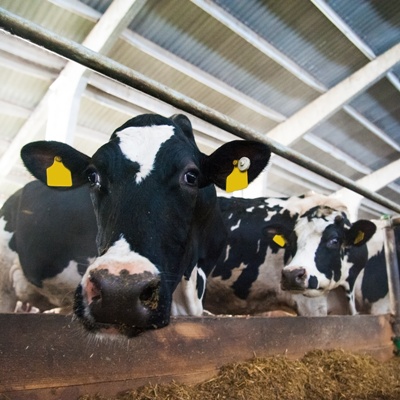
There are 6 main breeds of dairy cows, there are more but these are the most popular including Jersey, Holstein, Guernsey, Ayrshire, Milking Shorthorn, and Brown Swiss. All of these cows produce wonderful milk. Jerseys and Guernseys will provide you with the most cream. Holsteins are more commonly used because they provide a lot of milk. They are probably the most recognizable dairy cows because of their pretty black and white markings.
Dale Drendel
Hampshire, IL
Do cows continue to produce milk after their calf has been taken away? At what age are cows first bred?
Dairy cows are amazing animals! They can turn grass and grains into milk! Heifers are female dairy cattle and after two years, they usually give birth to their own calves. All female dairy cows must have a calf to produce milk. The cow will continue to produce milk for about 305 days. The gestation (pregnancy) period for cows is nine months. Newborn calves weigh about 80-100 pounds. Male dairy cattle are called bulls and do not produce milk.
Dale Drendel
Hampshire, IL
Do you feel wind turbines can affect farm animals and even cause them to die?
Our farm has had wind turbines on all sides of us (within 1500 feet) for seven years. We have and continue to finish out feeder cattle in our feedlot, finish out pigs, and have horses, dogs, and cats. We have experienced no ill effects on any of these animals. We have lived on this farm for 25 years. There has been no change in the health of our livestock or companion animals since the construction of the wind farm. As we enjoy watching many aspects of the turbines (wind presence, wind direction, and how they change appearances according to the weather,) and we appreciate the income, we consider the wind farm to be a big benefit to our well-being, and we are very thankful for it.
Scott Jensen
Tiskilwa, IL
How are growing season's determined? What are standard growing seasons for Northern States, States in the middle of the US and southern states? How many states can grow year-round?
Illinois farmers begin
planning for the next growing season far in advance. When spring does come
farmers closely watch the weather, air and soil temperature. Germination
happens at different temperatures for different seeds. That’s why farmers can
plant more cold-tolerant crops, like oats, earlier than corn. Even in our
state, planting time varies. But once warm enough temperatures are reached and
there’s enough sunshine to dry out our fields, planting will begin in the south
and move up into our more northern regions. In Illinois you may see planting
begin as early as March and continue through even June. Steve Ruh’s goal in
northern Illinois is to begin planting by April 15, but weather is always a
factor. Read about it here.
How are subtherapeutic antibiotics used in animal agriculture in Illinois?
Farmers use antibiotics in livestock production for three main reasons:
• for treatment of diseases
• prevention of disease
• nutritional efficiency or growth promotion
For the most part, some antibiotics are used in the swine and poultry industries for the purpose of growth promotion. Farmers use these products in a safe manner, and work with their veterinarian to ensure they are using the products responsibly. These products have a very short half-life, and depart the tissues of the animal very quickly – often in a matter of hours. The animals that have been treated are not marketed until a withdrawal period has been met to ensure there are no longer any antibiotics in the animal’s system. The USDA does a considerable amount of tissue sampling to ensure animals entering the human food chain are not tainted with antibiotics.
The beef industry does use some antibiotics at low levels, primarily for the purpose of preventing liver abscesses. Again, these have been proven entirely safe, and producers are very careful to ensure these animals do not enter the food chain, and withdrawal times are adhered to.
Jim Fraley
Livestock Program Director
Illinois Farm Bureau
How do cows know when it's time to be milked?
Dairy cows are creatures of habit. They get used to a certain routine just as any of us do. If a dairy farm has a daily schedule of twice a day milking, the cows are used to being milked once in the morning and once in the evening. When a dairy cow's udder is emptied of milk, she starts producing more milk. If the milking interval becomes too long, her udder will become uncomfortable and she will let you know it by standing at the gate to be milked and/or bellering. If there is not a milking routine established, the cow will eventually "dry herself off" and not produce any milk. To maximize a dairy cow's milk production, the dairy farmer should maintain a consistent milking routine that equalizes the intervals between milkings. (Whether it's milking two times a day or three.)
Ron Lawfer
Dairy Farmer
Kent, IL
How do farmers decide the best time to sell thier crops?
Kenneth Franklin, Christian County, IL:
Selling grain is one of the most important activities a farmer does each year. There are many factors that affect "when" the grain is sold. The first factor is the physical location of the grain after it is harvested. If the grain is stored in the elevator, you can sell the grain any time after it is delivered to the elevator. However, if the grain is stored on the farm in grain bin, you will want to sell the grain after the farmer has hauled the grain to the elevator. When you deliver grain to the elevator will depend on weather and scheduling of other farm tasks. The second factor of the economics of when to sell the grain is much more complicated. The goal is to sell your grain at the highest price possible in order to make the most profit. The first step is to calculate your expenses to determine the grain price you need to pay for your expenses. This will be your "break-even" price. Any time you sell grain above this price you will make a profit. To sell at the highest price, farmers generally read the advice of grain marketing experts in newspapers and magazines, both in print and online. Some also pay for advice from grain marketing experts. Farmers and landowners will also attend meetings where grain marketing professionals will give advice on the expected price of grain during throughout the year. Grain marketing can be stressful. However, you are a good grain marketer if you sell your crop for more than it cost to grow it, and your selling price is in the top 1/3 of the high and low price for the year.
Doug Martin, Mt. Pulaski, IL:
Marketing the crop is one of the toughest parts of farming. One of the things that I try to do is figure out what all of my expenses are on a per acre basis. I also try to figure how much money I would like to make and add that to the expenses. Once I have a idea of what that will be, I figure my 5 year average yield history and multiply it by the price for my projected income. If that price is close to or above a profitable level, then I will sell a percentage of the bushels that I either have in the bin or expect to grow during a crop year. I do not sell all of my bushels at once. I try to space out my sales throughout the year. This allows for more of an average price instead of trying to get the highest price or ending up with the lowest price.
How do they keep little pigs warm when they are born during really cold weather?
How does one go about becoming a farmer?
Thank you for inquiring about becoming a farmer. My suggestion to you would be to check and see if there are any farmers in your area looking to hire some part-time help. You’ll benefit from having direction and guidance from somebody who’s been in the business a long time. The University of Illinois has a terrific website where many of your questions can be answered at www.farmdoc.org. It’s never too late to at least investigate a future opportunity. Good luck!
Jeffrey Butler
Blandinsville, IL
I am interested in becoming a farm owner one day. Although I would love to inherit my family farm, it's just not in the cards. What advice you can give me?
Thank you for submitting your question on how to get more involved in production agriculture. Most farms today are family owned and operated. In fact, in Illinois, ninety-four percent of all farms are family owned.
If you’re really serious about wanting to pursue your dream, I have a couple of ideas you can think about. For starters, try to connect with an existing, established farmer in your area. See if you can find some work as a hired farm employee. Learn as much as you can about farming from that person. Then, as land becomes available maybe you can trade labor for use of the farmer’s equipment. The cost to rent land these days averages from $200-$350 per acre, and the cost to purchase land averages around $10,000 an acre.
Another option for you to consider, is to contact your local Farm Services Agency (FSA). There are some federal loans available for young farmers who have worked in agriculture for at least three years and who can show that they’re in charge of making all the management and financial decisions.
My advice to you is to start out small, and work your way up. Good luck in your future endeavors.
Jeffrey Butler
Blandinville, IL
I’ve seen farms in my state that sell exclusively to certain poultry companies. What is the distinction between a family farm and an industrial farm?
Today 98 percent of all U.S. farms are owned by individuals, family partnerships or family corporations. Family farms can vary widely in size and characteristics. For some farmers, companies, cooperatives, or marketing contracts, can offer a dependable market for their products, and even provide them with tools and support. No matter how the farm decides to market their products, family farmers take great care to provide safe and healthy food for consumers.
See how Illinois farmers describe the family farms compared to industrial farms on our blog: part 1 and part 2.
I’ve seen hogs being transported in all weather conditions. How do you transport hogs when in the middle of a hot summer or the cold of winter?
Keeping the pigs comfortable and safe during transportation is a priority too. When pigs are being transported in semi-trailers during the winter the sides are boarded up to keep the cold air out and they get extra bedding to keep warm. In the summer the air moving through the trailer keeps them cool, and on hot days they also are sprayed down with water to help keep cool.
Brent Scholl
Hog Farmer
Polo, Illinois
I’ve seen some of those videos of farm animals being mistreated. How do I know that’s not normal on farms?
Those videos are disturbing, and we want you to know that the vast majority of farmers work hard everyday to prevent any type of animal mistreatment. We want consumers to feel good about the meat that comes from our farms. That means we must raise our animals responsibly – and that starts and ends with humane treatment. Treating animals humanely and keeping them healthy is our livelihood. It’s how we produce high-quality pork and beef that feeds all our families.
I’ve seen some very long buildings for hog housing. Why are hogs housed indoors? Are growing pigs allowed to run around?
As farmers, we are very concerned about the well-being of our animals. Regardless of whether farmers raise their animals indoors or outdoors, we all have a responsibility to provide for the proper care and treatment of the animals on our farm.
As a farmer, I have an obligation to provide the best care for my animals. That is why many farmers raise hogs in climate-controlled barns, where they are safe, protected from disease and predators, and more comfortable regardless of the temperature or weather outside. Today’s barns provide an environment with constant access to water, plenty of fresh air, water-misters to keep hogs cool during hot weather and heaters in the winter.
When pregnant, sows have their own pens so they can receive individual care from workers and so their newborn piglets are protected, since sows can be aggressive to one another. While the pigs are growing they are actually housed in group pens with plenty of space to run around with others. At my farm they are in groups of about 25 pigs.
Illinois farmers choose animal housing systems that allow us to best watch the health and growth of our animals, while keeping them safe and comfortable. Our farm families work together to care for our animals and provide a safe, healthy pork product for consumers.
Brent Scholl
Hog farmer
Polo, Illinois
What are the requirements for starting an urban farm in the city?
There is legislation pending before the Chicago Zoning Committee to lessen the City’s regulations concerning urban farming. The ordinance defines urban farms, rooftop gardens and community gardens. Within the City we typically see urban farms and gardens. The farms aren’t what farmers typically think of when they hear the word “farm” instead they’re lot sized raised beds that individuals or groups grow vegetables in. Under the ordinance groups and individuals would be allowed to sell their produce on-site or at a market.
For an individual to start an urban farm they would need a location and would have to contact the zoning department ((312) 744-3508)). What is more common is a group starting an urban farm- the same rules would apply but a group tends to have more access to capital. Under the ordinance proposed by Mayor Emanuel and current law, if an individual or individuals wanted to start an urban farm they would need to contact the zoning department. Under Emanuel’s ordinance urban farming are permitted by right so there’s limited hoops to jump through. More often than not we’re seeing container gardening and at-home gardening and individuals are calling that “urban farming” in those cases an individual would have to purchase the materials and go from there.
Bona J. Heinsohn, Director of Public Policy
Cook County Farm Bureau
What are typical work hours for a farmer?
A farmer's work can be very hard. The hours are long; I often work from sunrise to sunset. During planting and harvesting seasons, I rarely get days off. The rest of the year, I try and sell my crops for a good price, fix my machinery, and plan for the next year. I also raise 120 purebred registered Charolais cattle, and care for 30 head of Arabian horses. On my farm, the work continues all year round. The livestock must be fed and watered every day. I work hard to keep my farm neat and tidy. I also make sure my livestock is safe and healthy. I like being a farmer, despite the long hours sometimes. I like working outdoors and making a living off the land.
Sam Zumwalt
Warsaw, IL
What percentage of corn gets made into ethanol?
The U.S. ethanol industry currently uses 23 percent of the U.S. corn supply. Something else to consider: making ethanol doesn't use the part of the corn kernel that's good for livestock feed.
What’s ethanol, and why do we need it?
Ethanol is an alcohol made from renewable resources such as corn and other cereal grains, food and other beverage wastes and forestry by-products. Ethanol-blended fuel substantially reduces carbon monoxide and volatile organic compound emissions, which are precursors to ozone. Adding ethanol to gasoline reduces harmful emissions, lowers the cost of our transportation fuels – and reduces our reliance on foreign oil imports. Find more information about ethanol at www.ethanolfacts.com.
What’s high-fructose corn syrup, and is it bad for my family?
High fructose corn syrup (HFCS) is the naturally occurring sugar in corn, which is pulled out and used as a sweetener in processed foods. (Just like table sugar is the naturally occurring sugar in the sugar cane plant, pulled out and processed into the sugar you recognize.)
The American Medical Association says that our bodies process HFCS and table sugar exactly the same, and that HFCS doesn’t contribute to obesity any more or less than any other sugar. And according to the Center for Science in the Public Interest, linking obesity rates to HFCS is an urban myth.
When the weather affects the crops, how do the farmers recoup their losses?
Farmers are a vital part of the country’s economy. They help grocery stores stay stocked with fresh fruits, vegetables, and meats. Farmers rely on several things to help get them through a difficult farming year.
Crop insurance can provide financial relief to people who suffer the loss of their crops for whatever reason. Usually farmers lose their crops due to weather incidents that take place. These include rain, tornadoes, droughts, or floods. Most farmers purchase some type of crop insurance to protect themselves.
Some farmers never recoup their costs from a bad growing season. Sometimes they have to take a loss and rely on whatever savings they have stored up from previous years.
Burdette Rosendale
Augusta, IL
Why do you treat animals with antibiotics?
Just like you take a sick child to the doctor, the same holds true when one of our animals gets sick. We work with our veterinarian to diagnose the animal’s illness, treat it and nurse that animal back to health.
Wouldn’t our food be healthier if you didn’t use chemicals?
Much like people don’t want ants in the kitchen or weeds in the garden, corn and soybean farmers don’t want insects and weeds in our crops. Pests cause significant damage, spread diseases and destroy otherwise healthy crops.
When we need to use a pesticide or herbicide, we use the least amount possible, of the safest material possible. Farmers are trained and certified to apply chemicals by the Illinois Department of Agriculture. We also have to follow very strict rules from the EPA and FDA on how and when to apply farm chemicals. You can find more information at http://www.aicr.org/site/DocServer/FPC-E7B-FSPW.pdf